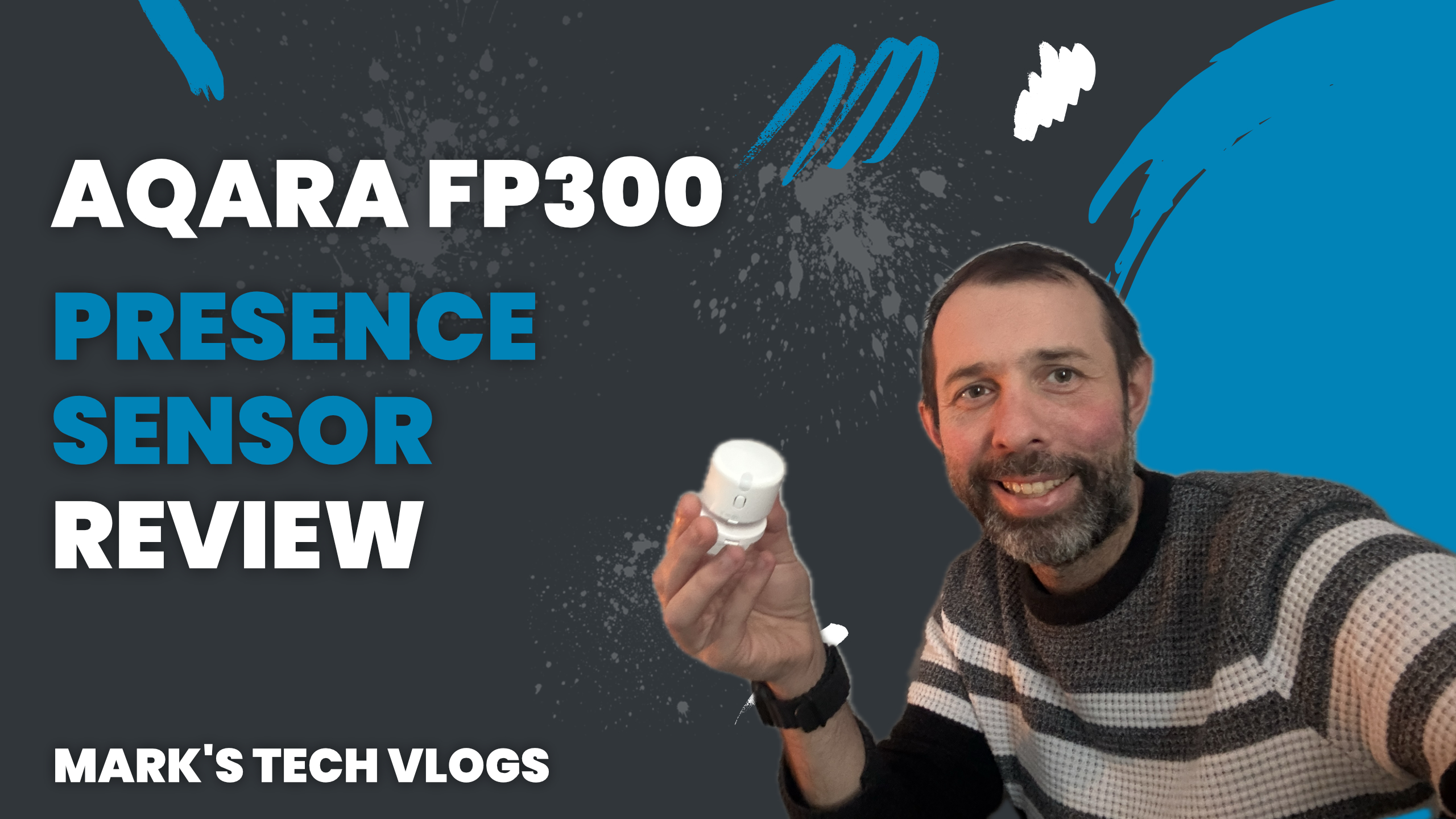
This is my in-depth review of the Aqara FP300 Presence Sensor, originally featured on Mark’s Tech Vlogs and now expanded into a full written review for Mark’s Tech Blogs.
If you’ve seen my comparison of battery powered presence sensors from Meross, Aqara, and SwitchBot, you’ll already know that the Aqara FP300 Presence Sensor came out as my favourite. It is also the most expensive of the three at around £50, but as I’ll explain, you do get a lot for that price.
If you want to maximise battery life and use the Aqara FP300 Presence Sensor in Zigbee mode, you’ll also need an Aqara Zigbee hub. Aqara hubs start at around £23 for a basic Zigbee-only option, with more advanced hubs offering extra features and local automation support.
Aqara FP300 Presence Sensor Specifications
The Aqara FP300 Presence Sensor offers a 120-degree field of view and a detection range of up to 6 metres. Presence detection is handled using a combination of 60GHz mmWave radar and an infrared PIR sensor, allowing it to detect even very subtle movement.
The sensor also includes AI learning, designed to improve accuracy over time and reduce false triggers from small pets. In my testing, it has been very good at ignoring pets on the floor, although a cat jumping onto a kitchen worktop can still trigger presence detection.
In addition to presence detection, the Aqara FP300 Presence Sensor also includes built-in light, temperature, and humidity sensors. All of these sensors are exposed to Apple Home, making it a very versatile addition to a smart home setup.
Matter, Thread, and Zigbee Support
The Aqara FP300 Presence Sensor supports both Zigbee and Matter over Thread, and you choose which mode to use during setup.
If you already have an Aqara hub, I recommend using Zigbee mode. This gives you the best battery life and access to more advanced configuration options within the Aqara app.
Being battery powered means there are no wires to worry about. In Thread mode, Aqara estimates around two years of battery life using the two included CR2450 batteries. In Zigbee mode, this increases to around three years.
After around two and a half months of real-world use, my Aqara FP300 Presence Sensor is still showing 100% battery, which is very impressive.
You can extend battery life even further by disabling some sensors when using Zigbee mode, although in practice most users will want to keep all sensors enabled.
Thanks to its dual-protocol support, the Aqara FP300 Presence Sensor is compatible with Apple Home, Google Home, SmartThings, Alexa, and Home Assistant.
In Zigbee mode, if your Aqara hub is already added to Apple Home, the sensor will simply appear automatically. In Thread mode, it needs to be added as part of the Matter setup process.
Configuration and Mounting Options
When using Zigbee mode, you gain access to additional configuration options, including detection mode, range adjustment, absence delay timings, and detailed temperature and humidity reporting.
The Aqara FP300 Presence Sensor can be wall mounted, ceiling mounted, or placed in a corner. It is not quite as flexible for corner mounting as Aqara’s wired presence sensors, but it still offers plenty of placement options.
Mounting is handled using the included magnetic plate, which can either be screwed into place or attached using adhesive.
There is no IP rating, and the sensor is rated for environments up to 90% humidity, so it is not recommended for use in bathrooms or very damp locations.
Design and Build Quality
The Aqara FP300 Presence Sensor has a compact, fully rounded design finished in white. It is smaller than you might expect, and the size of the box was genuinely surprising when I first opened it.
The simple design works particularly well against white walls and ceilings, helping the sensor blend into most rooms without drawing attention.
Installation Process
Installation is very straightforward. You remove the battery tab, mount the sensor in your chosen location, and then open the Aqara app.
From there, you select the Aqara FP300 Presence Sensor, choose whether you want to use Thread or Zigbee mode, and follow the on-screen steps. This may include pairing the sensor with an Aqara hub such as AFFILIATE_LINK_AQARA_HUB or AFFILIATE_LINK_AQARA_M3_HUB.
There is no calibration required, although you may want to tweak some settings after installation. Zigbee mode gives you more control, including sensitivity adjustments and AI learning options.
Real-World Usage and Automations
For the past two and a half months, I’ve been using the Aqara FP300 Presence Sensor in my kitchen alongside a Matter-compatible Govee light.
I’ve set up both presence and absence automations. These were initially created in Apple Home, but I later moved them into the Aqara app, which offers greater flexibility.
For example, in Apple Home, creating an automation based on both presence detection and ambient light levels requires converting the automation into a shortcut with additional conditions. In the Aqara app, these conditions can be combined directly in a single automation.
You can also configure absence detection to trigger only after a specific number of seconds or minutes, helping to minimise false triggers.
Using an Aqara M3 hub allows these automations to run locally, improving reliability and speed.
In my experience, automations run quickly and consistently in both Apple Home and the Aqara app. Aqara automations may be very slightly faster, but the difference is not noticeable in day-to-day use.
The sensor has remained online throughout testing with no dropouts.
The built-in temperature and humidity sensors are a welcome addition. If you use Aqara radiator valves, you can even use the Aqara FP300 Presence Sensor as the temperature source for more accurate heating control.
Downsides to Consider
There are very few downsides to the Aqara FP300 Presence Sensor. The main one is the higher price compared to other battery powered presence sensors.
You could also argue that battery life is reduced in Matter mode, but even then, two years of battery life is still very good considering the number of sensors included.
Final Verdict
The Aqara FP300 Presence Sensor is my favourite battery powered presence sensor available right now.
It is reliable, packed with useful sensors, and offers additional configuration options when used in Zigbee mode. The ability to switch between Matter and Zigbee provides excellent flexibility for different smart home ecosystems.
It’s also worth noting that despite receiving one unit for review, I’ve since ordered two more myself, which probably says everything you need to know.
